
Floral Mood Boost
This piece was created using oil paint and liquin glaze to thin the consistency of the paint. This creates a more transparent paint, which allows for the under layers to be more visible. An impasto technique was used to create thick brush strokes that remain visible in the work. This piece portrays a vase of flowers with medication bottles peaking in from the foliage. Pills litter the base of the piece as if they fell from the bouquet. The painting is done in neutral colors of purple, orange, green, and some white. I chose these colors to limit the visual clutter and allow viewers to create their own understanding of the content.
This piece is intended to highlight the similarity in feelings of receiving flowers to the joy of obtaining medications for mental illnesses. I used flowers to demonstrate the emotions of care, beauty, and the feeling of being special. For many, medications allow for their first experience of true feeling. Flowers can relate in a way where people can truly feel seen, heard, or understood in their situation.
Imprisoned
Imprisoned is a work centered on the experience of feeling trapped within one’s own body—an internal confinement shaped not by outside forces, but by the self. Built around the form of a rib cage, the piece uses the structure of the body as both barrier and metaphor. The ribs curve inward, creating a sense of pressure and enclosure, as though the figure is held captive by the very frame meant to protect it. This skeletal form becomes a visual representation of being lost inside oneself, struggling against limits that cannot be escaped because they come from within.
To counterbalance this heaviness, I shaped the sides of the piece into the soft suggestion of a dress and skirt. These flowing edges introduce a gentle contrast to the rigid ribs, offering a brief sense of movement and freedom. They serve as a reminder that the feeling of imprisonment is internalized—not absolute. The outer form hints at possibility, at the parts of ourselves that still reach outward even when the inside feels tight and unyielding. Imprisoned reflects the complicated space where identity, emotion, and the physical self collide—where the body becomes both home and restraint.

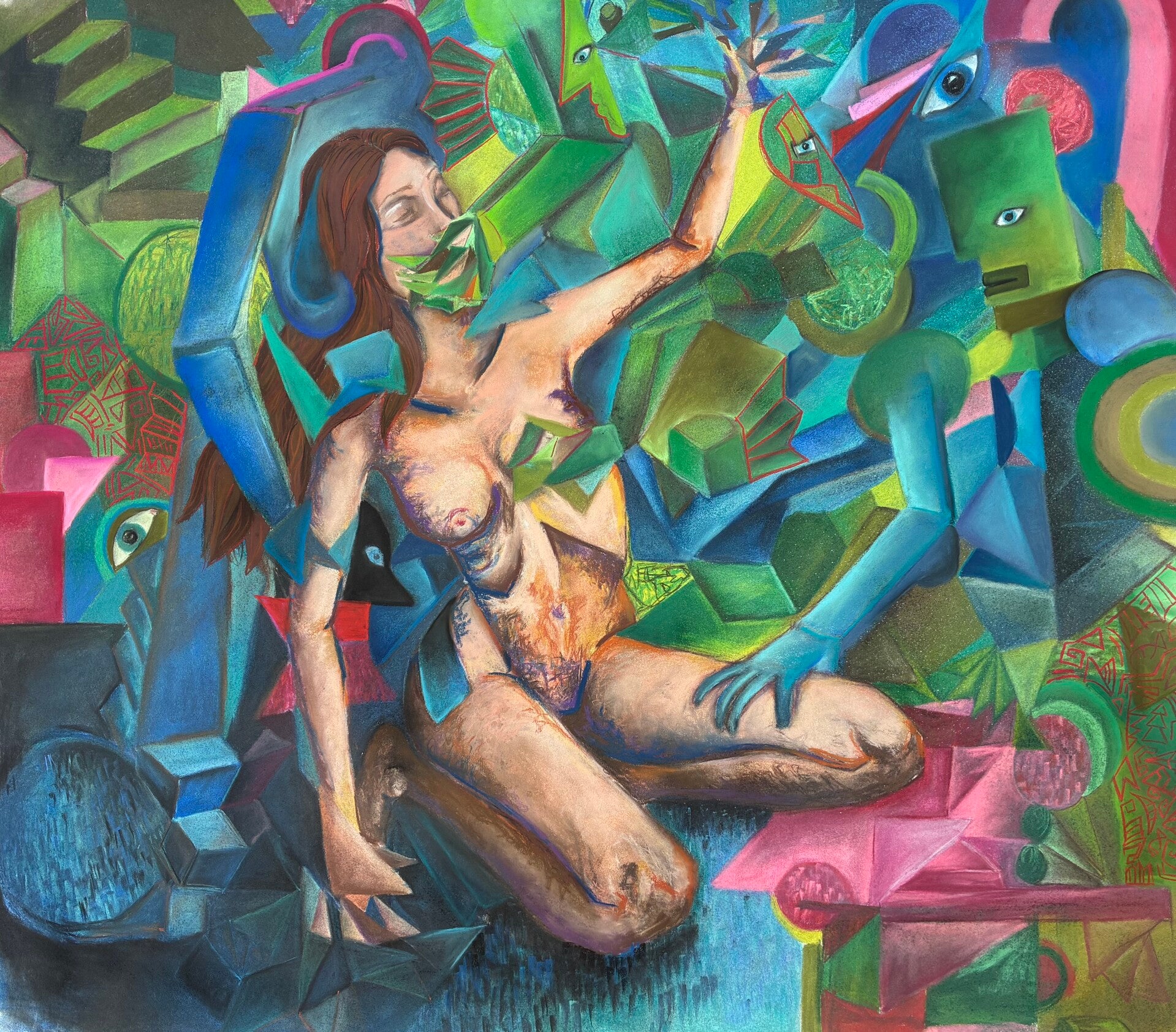
It Is All Men
It Is All Men is intended to speak about post-traumatic stress disorder (PTSD) from sexual violence through the medium of dry pastel. Using a cubist approach, I created a fragmented background, mirroring the disjointed nature of trauma. The work portrays a young woman on her knees, one arm reaching out, protectively, the other pressing against the ground for stability. Fragmented bodies reach toward her, breaking apart her form where they make contact. The color palette centers on greens and blues, with intentional points of pink that guide the eye to moments of emotional intensity.
The fragmented faces surrounding her symbolize two realities: the persistent fear survivors often feel toward others, even those who are not their perpetrators, and the painful truth that many survivors endure repeated assaults. By fracturing both the figure and the background, I sought to convey a sense of brokenness and disorientation. Layered within the composition creates a false sense of motion, a cyclical path that leads nowhere, underscoring the feelings of being stuck and unsafe. This piece embodies the difficult journey of healing, where survivors may strive for safety and recovery yet still feel lost within their own bodies and environments.
Do Not Pathologize Me
Do Not Pathologize Me grew out of my frustration with how easily strong emotions get labeled as something “wrong.” The piece takes the form of a vase covered in faces—each one showing a different emotion taken to an extreme: fear pulled tight across the eyes, anger carved sharply into the brow, disgust twisting the mouth, sorrow softening the whole expression, and joy breaking through in bright openness. They sit side by side, all crowding the same surface, because that’s what being human feels like sometimes: everything happening at once.
I coated the entire form with white gesso so the pen and ink lines would stand out, allowing me to draw directly onto the sculpture. The marks aren’t perfect or delicate; they’re scumbled, layered, and sometimes messy, the same way emotions spill over each other in real life. I added color in places where the feelings seem to overlap or bleed together, because none of these states exist on their own; anger touches fear, joy touches sorrow, and so on. What I wanted to push back against is the idea that having big feelings means something is medically wrong with you. These faces, though exaggerated, are intended to be familiar. They’re reminders that emotion is part of being alive, not a symptom to be diagnosed every time it shows up intensely. The vase holds all of them at once, the same way our bodies do, without needing to explain or apologize for any of it.


Create Your Own Website With Webador